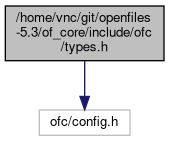
#include "ofc/config.h"
Go to the source code of this file.
|
| struct | _iovec |
| |
| #define | OFC_LARGE_INTEGER_HIGH(x) ((OFC_UINT32)((x)>>32)) |
| |
| #define | OFC_LARGE_INTEGER_LOW(x) ((OFC_UINT32)((x)&0xFFFFFFFF)) |
| |
| #define | OFC_LARGE_INTEGER_ASSIGN(x, y) x=y |
| |
| #define | OFC_LARGE_INTEGER_SET(x, y, z) (x)=(OFC_LARGE_INTEGER)(z)<<32|(y) |
| |
| #define | OFC_LARGE_INTEGER_EQUAL(x, y) (x==y) |
| |
| #define | OFC_LARGE_INTEGER_INCR(x) x++ |
| |
| #define | OFC_LARGE_INTEGER_AND(x, y, z) (x)&=((OFC_LARGE_INTEGER)(z)<<32|(y)) |
| |
| #define | OFC_LARGE_INTEGER_INIT(x, y) (OFC_LARGE_INTEGER)(y)<<32|(x) |
| |
| #define | OFC_ULONG_MAX ((OFC_ULONG)(~0L)) |
| |
| #define | OFC_LONG_MAX ((OFC_LONG)(OFC_ULONG_MAX >> 1)) |
| |
| #define | OFC_LONG_MIN ((OFC_LONG)(~OFC_LONG_MAX)) |
| |
| #define | OFC_DWORD_MASK 0xFFFFFFFF |
| |
| #define | TCHAR_BACKSLASH L'\\' |
| |
| #define | TCHAR_SLASH L'/' |
| |
| #define | TCHAR_COLON L':' |
| |
| #define | TCHAR_EOS L'\0' |
| |
| #define | TCHAR_AMP L'@' |
| |
| #define | TSTR(x) (const OFC_TCHAR *) L##x |
| |
| #define | TCHAR(x) (const OFC_TCHAR) L##x |
| |
| #define | TACHAR_BACKSLASH TCHAR('\\') |
| |
| #define | TACHAR_SLASH TCHAR('/') |
| |
| #define | TACHAR_COLON TCHAR(':') |
| |
| #define | TACHAR_EOS TCHAR('\0') |
| |
| #define | TACHAR_AMP TCHAR('@') |
| |
| #define | TASTR(x) TSTR(x) |
| |
| #define | TACHAR(x) TCHAR(x) |
| |
| #define | OFC_UUID_LEN 16 |
| |
| #define | OFC_NULL ((OFC_LPVOID) 0) |
| |
| #define | container_of(ptr, type, member) (type *)((OFC_CHAR *)(ptr)-(OFC_CHAR *)&((type *)0)->member) |
| |
| enum | { OFC_FALSE = 0
, OFC_TRUE = 1
} |
| |
| enum | OFC_LOG_LEVEL { OFC_LOG_FATAL = 0
, OFC_LOG_WARN = 1
, OFC_LOG_INFO = 2
, OFC_LOG_DEBUG = 3
} |
| |
| typedef long int | OFC_SIZET |
| |
| typedef int | OFC_INT |
| |
| typedef unsigned int | OFC_UINT |
| |
| typedef int | OFC_INT32 |
| |
| typedef short int | OFC_INT16 |
| |
| typedef char | OFC_INT8 |
| |
| typedef char | OFC_CHAR |
| |
| typedef char | OFC_BYTE |
| |
| typedef OFC_BYTE * | OFC_LPBYTE |
| |
| typedef unsigned char | OFC_UCHAR |
| |
| typedef void | OFC_VOID |
| |
| typedef long | OFC_LONG |
| |
| typedef OFC_LONG * | OFC_PLONG |
| |
| typedef short | OFC_SHORT |
| |
| typedef unsigned int | OFC_UINT32 |
| |
| typedef unsigned short int | OFC_UINT16 |
| |
| typedef unsigned char | OFC_UINT8 |
| |
| typedef unsigned long long int | OFC_UINT64 |
| |
| typedef long long int | OFC_INT64 |
| |
| typedef OFC_INT64 | OFC_LARGE_INTEGER |
| |
| typedef OFC_LARGE_INTEGER | OFC_OFFT |
| |
| typedef unsigned long | OFC_ULONG |
| |
| typedef OFC_ULONG * | OFC_LPULONG |
| |
| typedef OFC_UINT64 | OFC_ULONG_PTR |
| |
| typedef const OFC_VOID | OFC_CVOID |
| |
| typedef OFC_WCHAR * | OFC_LPWSTR |
| |
| typedef OFC_WCHAR * | OFC_LMSTR |
| |
| typedef const OFC_WCHAR | OFC_CWCHAR |
| |
| typedef const OFC_WCHAR * | OFC_LPCWSTR |
| |
| typedef const OFC_CHAR | OFC_CCHAR |
| |
| typedef OFC_CHAR * | OFC_LPSTR |
| |
| typedef const OFC_CHAR * | OFC_LPCSTR |
| |
| typedef OFC_UINT16 | OFC_WORD |
| |
| typedef OFC_UINT32 | OFC_DWORD |
| |
| typedef OFC_DWORD * | OFC_LPDWORD |
| |
| typedef OFC_UINT64 | OFC_DWORD_PTR |
| |
| typedef OFC_VOID * | OFC_LPVOID |
| |
| typedef OFC_VOID * | OFC_PVOID |
| |
| typedef const OFC_VOID * | OFC_LPCVOID |
| |
| typedef OFC_WCHAR | OFC_TCHAR |
| |
| typedef const OFC_WCHAR | OFC_CTCHAR |
| |
| typedef OFC_TCHAR | OFC_TACHAR |
| |
| typedef const OFC_TCHAR | OFC_CTACHAR |
| |
| typedef OFC_TCHAR * | OFC_LPTSTR |
| |
| typedef OFC_TACHAR * | OFC_LPTASTR |
| |
| typedef const OFC_TCHAR * | OFC_LPCTSTR |
| |
| typedef const OFC_TACHAR * | OFC_LPCTASTR |
| |
| typedef OFC_INT32 | OFC_MSTIME |
| |
| typedef OFC_UCHAR | OFC_UUID[OFC_UUID_LEN] |
| |
| typedef OFC_UINT8 | OFC_BOOL |
| |
| typedef struct _iovec | OFC_IOVEC |
| |
◆ container_of
| #define container_of |
( |
|
ptr, |
|
|
|
type, |
|
|
|
member |
|
) |
| (type *)((OFC_CHAR *)(ptr)-(OFC_CHAR *)&((type *)0)->member) |
Container of macro
- Parameters
-
| ptr | Pointer to field within structure |
| type | Type of structure |
| member | member name withing structure |
- Returns
- offset to member field within structure
◆ OFC_DWORD_MASK
| #define OFC_DWORD_MASK 0xFFFFFFFF |
The mask to associate with a double word
◆ OFC_LARGE_INTEGER_AND
Perform a binary AND between two 64 bit values
- Parameters
-
| x | Result of AND and first 64 bit value |
| y | low order 32 bit values to AND with |
| z | high order 32 bit values to AND with |
◆ OFC_LARGE_INTEGER_ASSIGN
| #define OFC_LARGE_INTEGER_ASSIGN |
( |
|
x, |
|
|
|
y |
|
) |
| x=y |
Assign one large integer to another
- Parameters
-
| x | 64 bit integer to receive assignment |
| y | 64 bit integer to assign |
- Examples
- test_file.c.
◆ OFC_LARGE_INTEGER_EQUAL
| #define OFC_LARGE_INTEGER_EQUAL |
( |
|
x, |
|
|
|
y |
|
) |
| (x==y) |
Compare two large integers
- Parameters
-
| x | First 64 bit integer to compare |
| y | Second 64 bit integer to compare |
- Returns
- OFC_TRUE if equal, OFC_FALSE otherwise
◆ OFC_LARGE_INTEGER_HIGH
| #define OFC_LARGE_INTEGER_HIGH |
( |
|
x | ) |
((OFC_UINT32)((x)>>32)) |
Return the high order 32 bits of a large integer
- Parameters
-
| x | A 64 bit integer that we wish to get the high order from |
◆ OFC_LARGE_INTEGER_INCR
| #define OFC_LARGE_INTEGER_INCR |
( |
|
x | ) |
x++ |
Increment a 64 bit integer
This insure carry if using two 32 bit values to represent a 64 bit value
- Parameters
-
| x | 64 bit value to increment |
◆ OFC_LARGE_INTEGER_INIT
Initialize one 64 bit value from two 32 bit values
- Parameters
-
| x | Low order 32 bit values to initialize with |
| y | High order 32 bit values to initialize with |
- Returns
- 64 bit value
◆ OFC_LARGE_INTEGER_LOW
| #define OFC_LARGE_INTEGER_LOW |
( |
|
x | ) |
((OFC_UINT32)((x)&0xFFFFFFFF)) |
Return the low order 32 bits of a large integer
- Parameters
-
| x | A 64 bit integer that we wish to get the low order from |
- Examples
- test_file.c.
◆ OFC_LARGE_INTEGER_SET
Initialize a large integer from two 32 bit integers
- Parameters
-
| x | A 64 bit integer to receive assignment |
| y | A 32 bit integer to assign to the low order 32 bits |
| z | A 32 bit integer to assign to the high order 32 bits |
- Examples
- test_file.c.
◆ OFC_LONG_MAX
Represents the maximum positive long value
◆ OFC_LONG_MIN
Represents the minimum negative long value
◆ OFC_NULL
A NULL Pointer
- Examples
- smbcp.c, smbinit.c, smbls.c, smbrm.c, test_dg.c, test_event.c, test_file.c, test_stream.c, test_thread.c, test_timer.c, and test_waitq.c.
◆ OFC_ULONG_MAX
Represents the maximum unsigned long value
◆ OFC_UUID_LEN
◆ TACHAR
| #define TACHAR |
( |
|
x | ) |
TCHAR(x) |
A default API wide character
◆ TACHAR_AMP
| #define TACHAR_AMP TCHAR('@') |
A default API wide character ampersand
◆ TACHAR_BACKSLASH
| #define TACHAR_BACKSLASH TCHAR('\\') |
A default API wide character backslash
◆ TACHAR_COLON
| #define TACHAR_COLON TCHAR(':') |
A default API wide character colon
◆ TACHAR_EOS
| #define TACHAR_EOS TCHAR('\0') |
A default API wide character end of string
◆ TACHAR_SLASH
| #define TACHAR_SLASH TCHAR('/') |
A default API wide character slash
◆ TASTR
| #define TASTR |
( |
|
x | ) |
TSTR(x) |
A default API wide character String
◆ TCHAR
A wide character
- Parameters
-
| x | Character to convert to wide |
- Examples
- test_file.c.
◆ TCHAR_AMP
A wide character ampersand
◆ TCHAR_BACKSLASH
| #define TCHAR_BACKSLASH L'\\' |
A wide character backslash
◆ TCHAR_COLON
◆ TCHAR_EOS
◆ TCHAR_SLASH
◆ TSTR
◆ OFC_BOOL
Represents a Boolean value
This should be a 8 bit value on a windows system to be compatable with Windows BOOL
◆ OFC_BYTE
Another representation of a character byte
◆ OFC_CCHAR
Represents a constant character
◆ OFC_CHAR
Represents a character byte
◆ OFC_CTACHAR
Represents a wide character constant
◆ OFC_CTCHAR
Represents a wide character constant
◆ OFC_CVOID
Represents a void constant
◆ OFC_CWCHAR
Represents a constant wide character
◆ OFC_DWORD
◆ OFC_DWORD_PTR
Represents a pointer to a double word
◆ OFC_INT
Represents a generic platform default integer
◆ OFC_INT16
Represents a 16 bit signed integer
◆ OFC_INT32
Represents a 32 bit signed integer
◆ OFC_INT64
Represents a signed 64 bit value
◆ OFC_INT8
Represents an 8 bit signed integer
◆ OFC_IOVEC
An IO Vector used by SASL
◆ OFC_LARGE_INTEGER
Represents a generic large integer
◆ OFC_LMSTR
Another representation of a pointer to a wide character string
◆ OFC_LONG
Represents a generic long value
◆ OFC_LPBYTE
A pointer to a character byte array
◆ OFC_LPCSTR
Represents a pointer to a constant character string
◆ OFC_LPCTASTR
Represents a pointer to a default API wide character constant string
◆ OFC_LPCTSTR
Represents a pointer to a wide character constant string
◆ OFC_LPCVOID
Represents a pointer to a constant element
◆ OFC_LPCWSTR
Represents a pointer to a constant wide character string
◆ OFC_LPDWORD
Represents a pointer to an array of double words
◆ OFC_LPSTR
Represents a pointer to a character string
◆ OFC_LPTASTR
Represents a Pointer to a default API wide character
◆ OFC_LPTSTR
Represents a Pointer to a wide character string
◆ OFC_LPULONG
Represents a pointer to an Unsigned Long
◆ OFC_LPVOID
Represents a pointer to a void element
◆ OFC_LPWSTR
Represents a pointer to a wide character string
◆ OFC_MSTIME
Represents a Millisecond time value
◆ OFC_OFFT
Represents an offset into a structure
◆ OFC_PLONG
Represents a pointer to a generic long value
◆ OFC_PVOID
Another representation of a pointer to a void element
◆ OFC_SHORT
Represents a generic short value
◆ OFC_SIZET
Represents the size of a string or structure
◆ OFC_TACHAR
Represents a wide character
◆ OFC_TCHAR
Represents a wide character
◆ OFC_UCHAR
Represents an unsigned 8 bit character
◆ OFC_UINT
Represents a generic platform default unsigned integer
◆ OFC_UINT16
Represents a 16 bit unsigned integer
◆ OFC_UINT32
Represents a 32 bit unsigned integer
◆ OFC_UINT64
Represents an unsigned 64 bit value
◆ OFC_UINT8
Represents an 8 bit unsigned integer
◆ OFC_ULONG
Represents a generic unsigned long value
- Examples
- test_file.c.
◆ OFC_ULONG_PTR
Represents a pointer to a 64 bit value
◆ OFC_UUID
◆ OFC_VOID
Represents a generic VOID
◆ OFC_WORD
Represents a Generic WORD
◆ anonymous enum
Values of a Boolean
| Enumerator |
|---|
| OFC_FALSE | The value is false
|
| OFC_TRUE | The value is true
|
◆ OFC_LOG_LEVEL
Log Level
Values that represent the criticality of a log message and the threshold of logging on the system
| Enumerator |
|---|
| OFC_LOG_FATAL | Fatal error
|
| OFC_LOG_WARN | Warning
|
| OFC_LOG_INFO | Info Level
|
| OFC_LOG_DEBUG | Debug Only
|



 1.9.1
1.9.1